
Thickened and Damaged Toenails
A toenail you cannot cut yourself. A nail that hurts under the pressure of a shoe. A nail that grew back ridged, split or lifting after a heavy weight landed on it a decade ago. None of these are ingrown toenails, and all of them are treatable.
What we see
- Thickened nails that have become too hard to cut with ordinary clippers, often on the big toe.
- Ridged or split nails where the same line reappears every time the nail grows out.
- Lifting nails that have separated from the nail bed and catch on socks and bedding.
- Nails that hurt under pressure, in a shoe, a boot or under a duvet.
- Nails deformed after an old injury, sometimes years after the injury itself healed.
- Discoloured nails where fungal infection may or may not be the cause.
Why an old injury keeps showing in the nail
Your nail is produced by the matrix, which sits hidden under the skin behind the visible nail. The matrix is the factory. The nail you can see is the product.
If the matrix itself was damaged when the toe was injured, it can be left with a scar, and a scarred matrix produces a scarred nail. Every time. That is why a nail can split in the same place for twenty years. The nail is not failing to heal, it is faithfully reproducing damage further back.
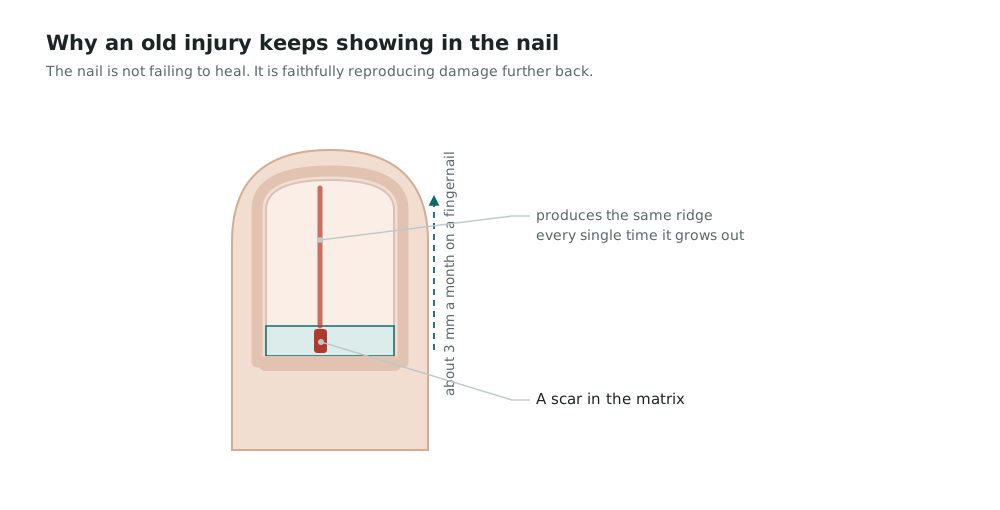
Swipe the diagram to see it all, or tap it to open full size.
The honest part
We would rather say this here than have you find it out in the chair.
Surgery cannot un-scar a matrix. If the ridge or split in your nail comes from a scarred matrix, removing the nail will not change what grows back, because the same factory makes the same product. Any clinic promising you a perfect nail from a scarred matrix is promising something it cannot deliver.
What we can do, and do regularly, is deal with the consequences, which is usually what is actually bothering you. A thickened nail that hurts in a shoe. A lifting nail that catches. An edge that keeps getting infected. A nail that has become more trouble than it is worth.
What we can offer
An assessment on its own
Plenty of people come in simply to find out what is going on, having never had it explained. That is a perfectly good reason to book, and you are not committing to surgery by asking.
Professional reduction and thinning
Many thickened nails do not need a procedure at all. They need cutting back and thinning properly, with the right instruments, at sensible intervals. You cannot do this at home with a nail in that condition, and trying is how people end up with a bleeding toe.
Partial nail avulsion
Where one side of the nail is the problem, an edge that catches, digs in or keeps becoming infected. That side is removed and its matrix treated so it does not regrow.
Total nail avulsion
Where the whole nail is beyond use, painful under any pressure, or repeatedly infected. More on total nail avulsion, including the decision about whether the nail is allowed to regrow.
One thing to take seriously. A dark streak running the length of a single nail, a change in colour under the nail, or a nail change that has appeared without any injury you can remember, should always be looked at by a doctor. In the great majority of cases it is harmless. It is checked because of the small number of cases where it is not, and because checking is easy.
Common questions
Is my thick nail fungal?
Sometimes, and sometimes not. Old trauma, psoriasis and pressure from footwear all thicken nails too. It matters, because antifungal treatment does nothing for a nail that has no fungus in it. See fungal toenail treatment.
My nail has been like this for years. Is it too late?
No. There is no time limit on being assessed, and a settled nail is actually easier to give you a straight answer about.
Is this cosmetic?
Sometimes. More often people come because the nail hurts, catches or keeps getting infected. Both are legitimate reasons to do something about it.